Ahmed Aredah: Building Large-Scale Simulation Engines for Sustainable Transportation
Welcome to the official website of Ahmed S. Aredah — a C++ software engineer and simulation researcher who designs and builds high-performance, large-scale simulation engines for freight, energy, and emissions analysis.
About Me
I am an Assistant Research Scientist at the Texas A&M Transportation Institute (TTI). I hold a Ph.D. in Civil Engineering and a Master’s in Computer Science from Virginia Tech. My core expertise is modern C++ development — architecting modular, cross-platform simulation software that models the physics of trains, ships, and multimodal freight networks at national scale. Alongside this, I build production-grade scientific tooling and decision-support platforms for transportation and air-quality programs.
What I Do
I write high-performance C++ to solve large-scale simulation problems. My simulators are open-source engines built with C++17 and Qt6, featuring modular architectures, physics-based dynamics models, and network-level optimization. Where simulation meets data, I extend this work with Python/R scientific libraries, end-to-end data pipelines, and web-based platforms that turn model output into actionable insight.
Simulation Engines (C++ / Qt6)
During my PhD at Virginia Tech and my work at TTI, I designed and built a full suite of open-source simulation tools for optimizing freight logistics, energy consumption, and multimodal network performance across the United States. The diagram below illustrates the simulation ecosystem I built — each module shown was developed by me, with the exception of the Integration component.
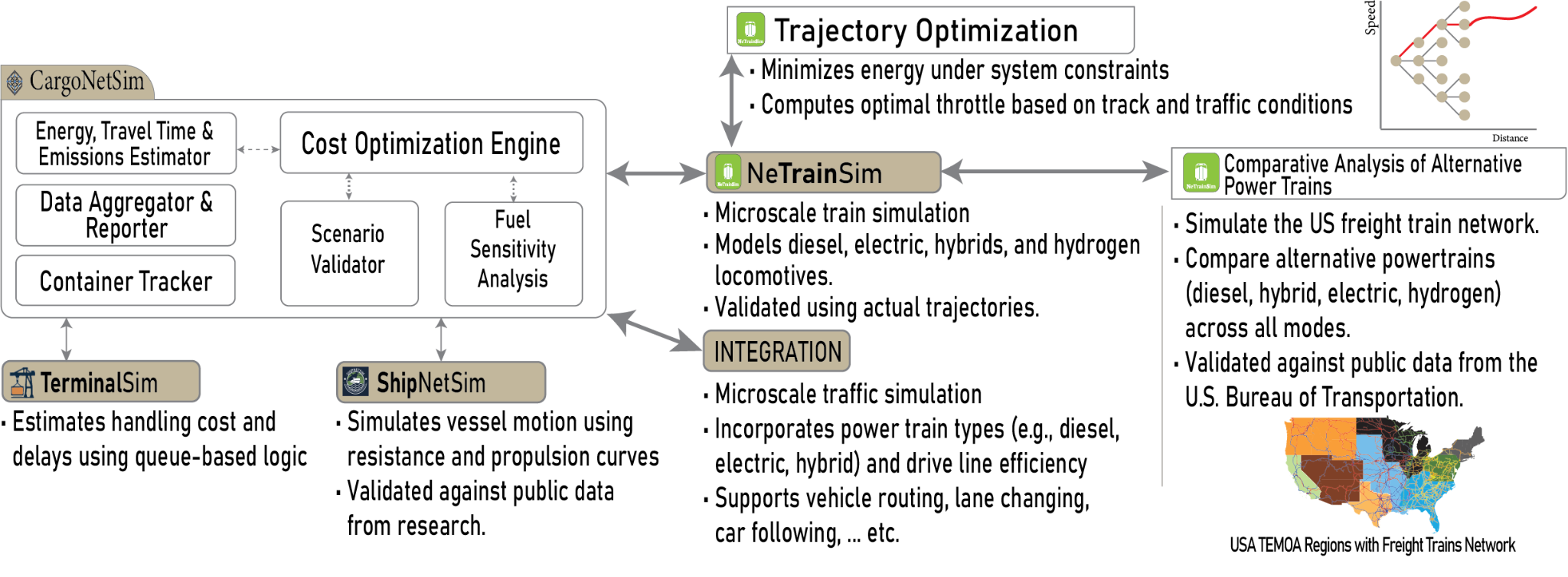
- CargoNetSim — A multimodal freight operations optimization engine with an interactive GUI, built in C++17 and Qt6. Orchestrates end-to-end freight movement across rail, ship, and terminal systems with route optimization and cost minimization. Cross-platform (Windows, Ubuntu, macOS).
- NeTrainSim — The first open-source, network-level C++ simulator for longitudinal freight-train motion and energy consumption across the entire U.S. rail network, with multi-train conflict resolution and support for alternative powertrains (diesel, electric, hydrogen).
- ShipNetSim — An open-source multi-ship maritime simulator (Qt6) combining Holtrop resistance and B-Series propeller hydrodynamics, a traffic-flow-inspired ship-following model, real-time environmental data, and cybersecurity threat simulation — validated within 13.1% of operational fuel estimates.
- TerminalSim — Models port and terminal operations to evaluate throughput and optimize loading/unloading.
These engines empower stakeholders — from policymakers to industry leaders — to make data-informed decisions aligned with national decarbonization strategies and infrastructure modernization goals.
Research & Development Highlights
- ShipNetSim and NeTrainSim: Open-source C++ simulators I developed for evaluating energy consumption and emissions across maritime and rail freight networks.
- Multi-Decadal Decarbonization Pathways (DOE, ARPA-E): Contributed to a $1.5M federally funded project simulating energy use for diesel, bio-diesel, and hydrogen-powered trains.
- Door-to-Door Freight Optimization (USDOT UTC): Developed agent-based modeling frameworks (CargoNetSim) for improving U.S. freight logistics using simulation and predictive analytics.
- Port Optimization at Norfolk International Terminal (Moffatt & Nichol): Boosted throughput by 375% through dynamic modeling and custom simulation tools.
Beyond Simulation: Scientific Tooling & Decision-Support Platforms
At TTI I also lead the development of production-grade software for state and federal air-quality and transportation programs — architecting Python/R scientific libraries, packaged toolchains, and web platforms deployed for TxDOT, EPA, TCEQ, CAPCOG, and MPO partners. Representative systems include the MOSERS decarbonization-strategy platform, the AQMS air-quality master schedule application, the MOVES Utilities suite (MOVES4/MOVES5), and statewide PM2.5 source-apportionment and emissions-inventory pipelines.
Industry & Infrastructure Experience
- Built web-based infrastructure and simulation platforms using Azure, React.js, TypeScript, and FlexTerm.
- Led training and technical presentations for stakeholders on simulation, dynamics modeling, and system integration.
- Designed highway and port infrastructure for multi-million-dollar national projects using BIM, Civil 3D, and scheduling software.
Publications
I have authored several peer-reviewed articles in journals such as Applied Energy, Railway Engineering Science, Journal of Marine Science and Engineering, and Energies. My work has been presented at international conferences including the Transportation Research Board (TRB) and the IEEE Smart Mobility Conference.
Selected publications:
- ShipNetSim: An Open-Source Simulator for Real-Time Energy Consumption and Emission Analysis, Journal of Marine Science and Engineering, 2025
- Energy Optimization in Freight Train Operations, Applied Energy, 2024
- Comparative Analysis of Alternative Powertrains, Applied Energy, 2024
- NeTrainSim: A Network-Level Simulator, Railway Engineering Science, 2024
Full list of publications:
Google Scholar | ORCiD | ResearchGate
Selected Technical Reports
- Agent-Based Approaches in Freight Systems: Towards a Door-to-Door (D2D) Freight Optimization — Final report, UTC Program, U.S. Department of Transportation ($100K), 2025.
- Energy Consumption Modeling of Ships: Towards a Door-to-Door (D2D) Freight Optimization — Final report, UTC Program, U.S. Department of Transportation ($100K), 2024.
- Multi-decadal Decarbonization Pathways for U.S. Freight Rail (A-STEP) — Final report, U.S. Department of Energy (DOE) and ARPA-E ($1.5M), 2023.
- COVA Digital Twin — System Development and Demonstration — Final report, Virginia Department of Transportation ($150K), 2023.
Technical Expertise
- Core: Modern C++ (C++17), Qt6, object-oriented design, high-performance & large-scale simulation
- Programming: Python, R, C#, JavaScript, TypeScript, React.js, MATLAB, SQL/NoSQL
- Python/R Stack: NumPy, Pandas, SciPy, Scikit-learn, TensorFlow, PyTorch, Shiny, Quarto, PyInstaller
- Simulation & Modeling: CARLA, SUMO, PTV Vissim, MOVES4/MOVES5, ArcGIS Pro, QGIS
- DevOps & Cloud: Git/GitHub, GitHub Actions (CI/CD), Docker, Microsoft Azure, Nginx, Linux/VPS deployment
- Infrastructure Design: BIM, Revit, Navisworks, Civil 3D
Professional Service — Peer Reviewer
- Transportation Research Board (TRB) — 2024–present
- Green Energy and Intelligent Transportation — 2024–present
- Transportation Research Record — 2021–present
- IEEE Transactions on Intelligent Transportation Systems — 2023–present
- IFAC Symposium on Control in Transportation Systems — 2024–present
Affiliations
- Transportation Infrastructure and Systems Engineering, Virginia Tech
- Transportation and Development Institute (TDI), American Society of Civil Engineers (ASCE)
- American Railway Engineering and Maintenance-of-Way Association (AREMA)
Recognitions & Awards
- First Place, 2025 SMARTER Student Poster Competition
- Last Mile Leadership Scholarship, U.S. Department of Energy (LODESTAR Program)
Teaching & Mentorship
Former Teaching Lecturer at the German University in Cairo, where I delivered over 10 courses in civil engineering and architecture. At TTI, I mentor junior staff and lead internal workshops on Git/GitHub workflows, Docker-based deployment, and reusable software design.
Let’s Connect
Explore my software, research, and tools showcased here. I’m open to academic, governmental, and industry collaborations. Connect with me on LinkedIn, view my code on GitHub, or reach out via email.
Together, let’s engineer the future of sustainable infrastructure and intelligent transportation systems.